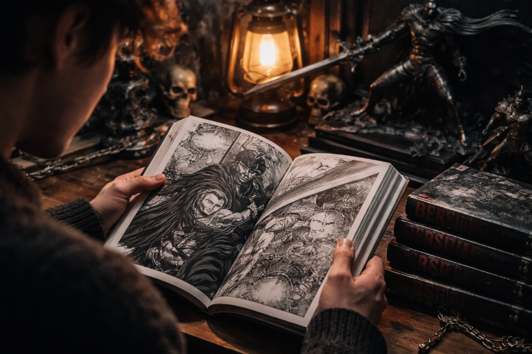
Some stories don’t just entertain they carve scars across your imagination. Berserk, the legendary manga by Kentaro Miura, is one such work. Known for its gritty violence, philosophical depth, and haunting visuals, it has captured the minds of readers worldwide. But what exactly is the story behind Berserk? Where did it begin, how did it evolve, and what makes it stand apart in the vast universe of Japanese manga? If you’ve ever wondered about the origin of Guts’ never-ending battle, the cursed Brand, or the infamous Eclipse, you’re in the right place. Here’s a detailed journey through the blood-soaked pages and emotional crescendos of Berserk — a tale where pain meets purpose, and darkness has its own twisted beauty. Follow the path of the Black Swordsman and uncover the depths of a world as cruel as it is captivating.
The early years of Berserk and its brutal foundations
The manga Berserk was born in 1989, appearing in the pages of Monthly Animal House. At first glance, it might have seemed like just another medieval fantasy, but beneath the armour and steel hid something far more visceral. Kentaro Miura’s world-building was unlike anything readers had encountered. Towering apostles, blasphemous rituals, and psychological torment became the norm not the exception. One of the earliest arcs, known as the Black Swordsman, introduces Guts, a lone mercenary with a prosthetic arm and a blade too massive for any man to wield. He is not a hero in shining armour but a man consumed by hatred. Readers were thrust into this hostile landscape, with Guts slashing his way through grotesque demons and corrupted humans. These early volumes laid the groundwork for what would become one of the most unforgiving yet magnetic narratives in manga history. The link between visual horror and emotional trauma gave Berserk a unique identity. If you ever browsed anime figures tied to the series, you’d quickly notice they are not your typical collectibles. These statues and busts capture anguish, defiance, and devastation recurring themes embedded deep into the DNA of Berserk.
The Golden Age arc: rise, betrayal and the Eclipse
At the heart of the manga’s popularity lies the Golden Age arc. This lengthy flashback is widely regarded as the crown jewel of the entire series. It traces the journey of Guts from his youth to his rise within the mercenary group, the Band of the Hawk. Led by the charismatic and enigmatic Griffith, this group begins as a ragtag band of warriors and evolves into a military force praised by kings. During this arc, Miura masterfully balances brutality with vulnerability. Readers discover Guts’ past born from a corpse, raised by mercenaries, and shaped by violence. His camaraderie with Griffith and Casca brings rare warmth to an otherwise hostile world.


But this warmth is a precursor to catastrophe
As Griffith’s ambition grows unchecked, his actions become more extreme. His fall from grace, imprisonment, and desperate pact with demonic entities set the stage for the Eclipse. This event a metaphysical bloodbath where most of the Band of the Hawk is slaughtered is burned into the memory of every Berserk reader. It marked the transformation of Griffith into Femto, one of the God Hand, and turned Guts and Casca into broken souls. The visual intensity of this chapter is rivalled only by its emotional devastation. The horror is palpable not just in the violence, but in the betrayal. Today, fans still debate the psychological symbolism of the Eclipse. And if you’ve explored Berserk figures online, many of the most chilling pieces are tributes to this very moment.
The Black Swordsman and the path of vengeance
Following the Eclipse, Berserk returns to its present timeline. Guts, now marked with a cursed Brand attracting evil spirits, becomes the Black Swordsman. He is no longer a soldier seeking purpose but a man driven by pure vengeance. His hunt for Griffith, now reborn as Femto, propels him through haunted landscapes, monstrous apostles, and spiritual realms. The narrative grows darker if that’s even possible. Miura introduces theological themes, exploring free will, causality, and divine manipulation. Guts battles both literal and internal demons, torn between hatred and the remnants of his humanity. Casca, traumatised into silence, becomes the fragile thread connecting him to his past self.
As the story unfolds, readers witness the evolution of Guts’ weaponry, tactics, and companions. He assembles a new band Farnese, Serpico, Isidro, Schierke each bringing light into Guts’ abyss. Through them, we’re reminded that even the darkest souls seek solace. This arc also dives deeper into the Behelit, an egg-shaped talisman tied to fate. Its chilling grin reflects the cruel paradox of Berserk: salvation often comes at the cost of one’s soul. Key elements of this arc :
- Brand of sacrifice
- Behelit and fate
- Skull Knight and his cryptic wisdom
- New apostles and the evolving threat
- Guts’ inner Beast of Darkness
This period of the manga mirrors the forging of steel intense, unrelenting, necessary. Guts’ transformation is both physical and metaphysical. The pain of survival carves him sharper than any blade.
Magic, myth and the expanding world of Berserk
As Berserk enters its later arcs, the narrative pivots toward mysticism. The introduction of Schierke, a young witch, opens a gateway to astral planes and spiritual warfare. Miura expands his universe, blending folklore, mythology and deep lore into a rich tapestry. The Fantasia arc marks this evolution. The barriers between the real and astral worlds collapse, leading to a new era of chaos. Familiar cities are overrun by mythic beasts. The geography becomes as fluid as dreams or nightmares.
The rise of Elfhelm
Elfhelm, a hidden sanctuary of magical beings, becomes a beacon of hope. Here, Casca regains fragments of her mind, and Guts confronts the limits of brute strength. This realm’s calm offers contrast to the brutal wastelands traversed earlier like sunlight after a storm. But peace is temporary in *Berserk*.
God Hand and the metaphysics of evil
Miura doesn’t just draw monsters. He explores what makes men monstrous. Through the God Hand Void, Slan, Ubik, Conrad, Femto he manifests cruelty, manipulation and ambition as divine inevitabilities. The struggle between destiny and resistance becomes central. Guts’ defiance is a blade against the concept of predestination itself. Reading this phase of Berserk is like entering a cathedral of despair breathtaking, overwhelming, transcendent.
See also: Bipolar Support Groups San Diego: Your Path to Connection and Resilience
The death of Miura and the future of Berserk
Kentaro Miura passed away in 2021, leaving a void impossible to fill. His death shook the manga world. Fans mourned not just the man but the unfinished tale. Yet, Berserk didn’t end. Miura’s close friend and colleague, Kouji Mori, was entrusted with continuing the story based on detailed notes and conversations shared over decades. With the help of Miura’s assistants at Studio Gaga, the manga resumed, carefully preserving its original tone, style and philosophical essence.
This transition is delicate. But so far, fans acknowledge the respect shown to Miura’s legacy. The continuation feels less like a sequel and more like a faithful echo guided by the spirit of the original. The question remains: where will Berserk end? Will Guts find peace? Will Griffith fall? These answers are pending, but one truth remains Berserk changed the manga landscape forever.
Legacy and cultural impact of Berserk
Few works in manga history rival Berserk in influence. Its DNA is found in video games (Dark Souls, Elden Ring), anime (Attack on Titan, Claymore), Western media (The Witcher, Game of Thrones) and fashion (Rick Owens’ gothic designs).
Miura’s artistic genius every page meticulously detailed has inspired generations of artists. The dragonslayer sword, the apostles, the God Hand each concept has become iconic. Beyond aesthetics, Berserk leaves a philosophical imprint. It questions morality, purpose, suffering, love. Readers don’t just follow Guts they carry his weight. The manga doesn’t offer comfort, but it delivers catharsis. In an age of quick dopamine and shallow plots, Berserk demands patience and endurance. It’s not a series you consume; it’s one you survive.
Final thoughts and lasting impressions
Berserk is not simply a manga. It’s a lifelong companion for those who dare face its abyss. Its blend of horror, emotion and existential reflection offers something rare: brutal honesty. Each chapter draws blood, but also insight. The journey of Guts reminds us that strength isn’t about victory it’s about motion. Even when broken, he walks on. For anyone wondering whether to read Berserk, the answer is this: only if you’re ready to feel. To suffer. To grow. To understand why a cursed man, in a cursed world, still chooses to fight. And if you’ve already walked that path, feel free to share your interpretation. What moment struck you most? What part of Guts lives in you?